DimensionZ

Blog

  • X-Men: Ravages of the Apocalypse Mac Review (1998)

    X-Men: Ravages of the Apocalypse Mac Review (1998)

    This post has affiliate links. If you buy through them, we may earn a small commission at no extra cost to you. Learn more.

    From the archive: this review first ran on the Mac Gaming Alliance (MGA), the Mac games site that lived here on DimensionZ in the late 1990s. It was published January 1998 and is reproduced as originally written. More in the Mac Gaming Alliance archive.

    Publisher MacSoft
    Tested on PowerMac w/Power3D
    Gameplay 5 / 5 apples
    Graphics & Sound 5 / 5 apples
    Interface 5 / 5 apples
    Difficulty 4 / 5 apples
    Bugs 3 / 5 apples
    Overall 5 / 5 apples
    Reviewed by David Leinbach

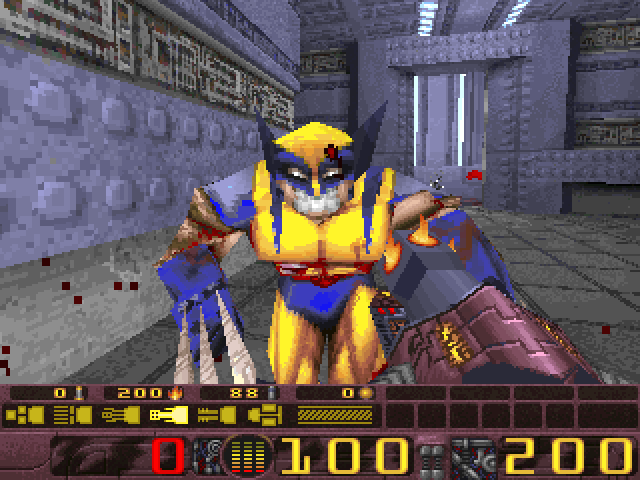
    X-Men: Ravages of the Apocalypse is the prefect add-on to Quake, it adds what Quake lacks, a PLOT! This is a TOTAL conversion for Quake, that means that everything is new, all-new weapons, sound effects, music, and enemies

    Gameplay

    As I mentioned, this game has a plot, a rather complex one at that. The Evil Apocalypse has cloned the X-Men into his own personal army for world domination. Where do you come into this? Magneto, while no friend of the X-Men, created you, an advanced cyborg to thwart Apocalypse’s evil plans. As a cyborg, your forearms morph into 7 all-new advanced weapons to be used against the sinister X-Clones. There are 12 different X-Men will be fighting, Archangel, Beast, Bishop, Cannonball, Cyclops, Gambit, Iceman, Phoenix, Psylocke, Rogue, Storm, and Wolverine. Of course all the X-Clones have their powerful mutant powers to use against you, i.e. when fighting Wolverine make sure that he is REALLY dead, otherwise his mutant healing factor will bring him back to surprise you.

    There are 18 levels in Ravages, each one is unique with it’s own puzzles and setting. There’s a real plot to follow and goals to achieve in every level.

    Without a doubt, multiplayer X-Men is WAY better than plain old multiplayer Quake. In Multiplayer X-Men you can play any of the 12 X-Men and use their unique mutant powers. You can have multiplayer games with players just using their mutant powers and no guns to find out which X-Man/Woman is really the most powerful.

    Screen shots

    320 by 240 Pixel Doubled

    640 by 480

    3Dfx Enhanced

    Graphics & Sound

    Coming into this, I had very high standards for the graphics in this game. I can honestly say that this surpassed even my highest expectations. In pixel doubled mode, the graphics were blocky but, in regular 640 by 480, the graphics were wonderful. The real beauty is in the 3Dfx accelerated edition, what can I say except “Absolutely Beautiful!”. For your own comparison, check out my screen shots to the left, they’re all of the same scene in the different resolutions.

    The music on the X-Men CD is perfect for the game, it adds just the right amount of atmosphere in. For me, the game just doesn’t seem right without this music. Sound effects for all the weapons are majestic, I’ve been reading the X-Men comics for about 4 years and the sounds in this game were just as I had always imagined them.

    Interface
    To play X-Men: Ravages of the Apocalypse, you launch a front-end application from which you can start a new game, start a multiplayer game, load an old game, view a cool comic-book style animated intro, and even enter in some extra “command-line parameters”. This is the first official product by the powerhouse mac porting company, Westlake Interactive, programmers from Westlake are responsible for such great Mac ports as Duke Nukem 3D, and Shadow Warrior so they knew what they were doing.

    Difficulty

    I have no qualms about the difficulty of X-Men, in fact I found it to be just the right balance of difficulty, a much better balance than Duke Nukem or even Normal Quake.

    Conclusion

    In conclusion, I found X-Men: Ravages of the Apocalypse to be the perfect add-on to Quake, I think that every Quake player out there should rush and get a copy of this! This one of the very few games that if I had a chance to remake it it, I would NOT change a thing! This is a must buy! I can not recommend this enough…

    Find a copy

    X-Men: Ravages of the Apocalypse has been out of print for years, but used copies of the original Mac release still turn up, and some classics have been re-released for modern systems. Search for X-Men: Ravages of the Apocalypse on Amazon.

  • Play to Win Casino Mac Review (1998)

    Play to Win Casino Mac Review (1998)

    This post has affiliate links. If you buy through them, we may earn a small commission at no extra cost to you. Learn more.

    From the archive: this review first ran on the Mac Gaming Alliance (MGA), the Mac games site that lived here on DimensionZ in the late 1990s. It was published January 1998 and is reproduced as originally written, with the original screenshots (click to enlarge). More in the Mac Gaming Alliance archive.

    Publisher MacSoft
    Tested on Performa 5260/100, 20mb RAM
    Gameplay 3 / 5 apples
    Graphics & Sound 4 / 5 apples
    Interface 5 / 5 apples
    Difficulty 3 / 5 apples
    Bugs 5 / 5 apples
    Overall 3.5 / 5 apples
    Reviewed by Jonathan Dreyer

    Finally, a realistic Casino game for the Mac. Play to Win Casino includes Slot Machines, Blackjack, Roulette, Video Poker, Craps, and Video Keno. And best of all, all the games have realistic odds! Although that means that you’ll be losing more often than winning.

    Gameplay

    The gameplay in Play to Win is very intuitive. Each when you go to play each game, you can use the step-by-step instructions to learn how to play, or you can learn the latest advanced strategies if you already know how to play. You can set the games to warn you if you’re making a bad bet or a good bet, let you know of the house edge on certain bets, and know which machines are “hot”. I suggest you turn on all of the computer advice when you first play because, as I said, these games have REAL Las Vegas odds meaning that no matter how good you become, the house will always win in the end, if you listen to the computer advice you’ll which games to play and which bets to make to avoid the house edge. You start off with $25,000 dollars, this may sound like a lot but, you can lose it pretty fast in this game.

    Also, in the Slot machines, Video Poker, and Video Keno games I hated having to drag my coins into the coin slot every time my credits ran out, until I found in the menus above there was an option to put in 200 credits at a time.

    Graphics & Sound

    Play to Win Casino’s sound effects are great! The sounds of the chips hitting the table, the sound of the slot machine spinning, the cards being dealt out, and all of the beeps that the Slot machines, video poker, and video Keno machines make when you win or lose. And those sounds don’t just sound like computer generated garble either, they sound like they were actually recorded from a Casino, although I doubt that is true.

    There’s nothing special about the graphics in Play to Win, I mean how fancy can you make the graphics in a Casino game? One complaint, though in the blackjack game I thought the graphics of the cards were a little blurry.

    Interface
    As usual, like any other MacSoft published game, I have no complaints about Play to Win’s interface, it has all the right Macintosh menu bars, menus, and dialogue boxes. This is definitely no half-assed port of a game.

    Difficulty

    As I said, one of Play to Win’s main attractions is the real Las Vegas odds, that means that the chances are that you will lose more money than you win but, if you want to use this to practice up before your trip to Vegas, great! This will make a great trainer and will hopefully keep you from losing big time when you actually go.

    Conclusion

    In conclusion, Play to Win Casino is just about the only realisitc gambling game available for the Mac. If you like playing casino games on your computer or want to practice up for a trip to Vegas, this is for you! This is not a game I would recommend to everyone.

    Find a copy

    Play to Win Casino has been out of print for years, but used copies of the original Mac release still turn up, and some classics have been re-released for modern systems. Search for Play to Win Casino on Amazon.

  • Tonka Search and Rescue Mac Review (1998)

    Tonka Search and Rescue Mac Review (1998)

    This post has affiliate links. If you buy through them, we may earn a small commission at no extra cost to you. Learn more.

    From the archive: this review first ran on the Mac Gaming Alliance (MGA), the Mac games site that lived here on DimensionZ in the late 1990s. It was published around 1998 and is reproduced as originally written. More in the Mac Gaming Alliance archive.

    Publisher Hasbro Interactive
    Tested on Quadra 840AV, PowerMac 8500/150
    Gameplay 4 / 5 apples
    Graphics & Sound 5 / 5 apples
    Interface 4 / 5 apples
    Difficulty 3 / 5 apples
    Bugs 4 / 5 apples
    Overall 4 / 5 apples
    Reviewed by Martha Engber

    Have your kids take a drive through Tonka Search & Rescue (ages 4 and up), where my bet is they’ll have a grand time saving people and making repairs using backhoes, cranes, dump trucks and other cool Tonka vehicles.

    Gameplay

    When you enter Search & Rescue you meet a robust Tonka Joe, dressed for rescue, who introduces you to the dispatch center, which is the screen from which you can choose any of the five main activities, each introduced by a character. Hallelujah that two of the five characters are women with one, Rudy Forest the zookeeper, being a minority and the other, Suzy Sparks, being in a non-standard job for a woman (she’s in charge of the garage). That was a big plus for me, the mother of a 6-year-old daughter. The activities themselves seem to be legitimate in terms of number, work required and length of time to complete. Kids can go to Suzy’s garage, where they can equip and customize fire trucks and other vehicles. Choosing “Coach Blaze” means you’ll get a tour of the Tonka Academy where three skills are taught; fire fighting and rescue using a helicopter or motor boat. The meatiest activities, however, are the three missions, which are disaster scenes that the player must clean up and rebuild. One revolves around the burning dock warehouse. The second deals with the aftermath of an earthquake at a zoo in which animals have been set loose, cages wrecked and roads cracked. In the last, old New England fisherman “Nate Cod” takes you through a flooded neighborhood where neighbors need rescuing. For each mission kids accomplish, they get an award certificate from the print center along with a newspaper article featuring their heroism. They can also print out Tonka team member badges, license plates and sheets of patterns to cut out and assemble into construction sites. Envision your computer area awash in paper.

    Graphics and Sound

    The graphics don’t attempt to be photo quality, but rather feel like colorful cartoons that are not too busy to look at. The lion stretches, the St. Bernard pants, the river water runs and gurgles. Best of all, each scenario has a number of faceless little people, some of whom are victims while others are members of the rescue crew. For example, if during firefighter practice at Tonka Academy you don’t put out a manufactured blaze with some speed, the little firefighter helpers sit down and start playing cards. If you wait long enough, they’ll curl up, go to sleep and snore. In terms of detail, the pilings at the harbor have algae growing on them, the power drill in the garage zips loudly like a power drill, the flags wave in the breeze. When you click on vehicles, their engines start and continue to hum until they drive off the screen after completing an activity.

    Difficulty

    The program literature says it encourages kids “to use problem-solving skills, rescue know-how and imagination to get missions accomplished.” I didn’t find this to be the case. Each mission scenario begins by telling kids what to do first and brings them the proper vehicle. It would be better to have a selection of four vehicles at the top of the screen in order to give kids a chance to figure out which is the best vehicle for the job. Telling kids which jobs to do and when gives them little chance to problem-solve or prioritize. What the program does well, however, is teach persistence and task completion, which leads to my next point.

    Interface

    The program excelled at what I called the Patience/Frustration Factor, which is both good and bad. My kids had a hard time maneuvering the vehicles sometimes because it requires a sense of perspective. Take the helicopter at the zoo. You position it in a place you believe to be above the lion, yet when you drop the rescue basket, it lands two inches below the lion. That means you have to move the helicopter up and try dropping the basket again so it gets close enough so the lion will jump in. The same goes for using the backhoe to pick up boxes and pipes on the dock, etc. It’s frustrating to start with, but I found it gratifying that my daughter had to try again and again before getting it right. Besides, once a kid learns the feel of the vehicles, it’s a lot easier the second time. Keep in mind that you should run the program on a machine with a fast processor. otherwise is really tough to maneuver the vehicles. That’s what I found by trying it on my Quadra 840AV (too slow) then on my PowerMac (just right).

    Find a copy

    Tonka Search and Rescue has been out of print for years, but used copies of the original Mac release still turn up, and some classics have been re-released for modern systems. Search for Tonka Search and Rescue on Amazon.

  • Star Trek: Deep Space Nine Mac Review (1998)

    Star Trek: Deep Space Nine Mac Review (1998)

    This post has affiliate links. If you buy through them, we may earn a small commission at no extra cost to you. Learn more.

    From the archive: this review first ran on the Mac Gaming Alliance (MGA), the Mac games site that lived here on DimensionZ in the late 1990s. It was published around 1998 and is reproduced as originally written. More in the Mac Gaming Alliance archive.

    Publisher Viacom Newmedia
    Tested on Performa 5260 / 100 MHz
    Gameplay 3 / 5 apples
    Graphics & Sound 4 / 5 apples
    Interface 2 / 5 apples
    Difficulty 4 / 5 apples
    Bugs 4 / 5 apples
    Overall 3 / 5 apples
    Reviewed by Jonathan Dreyer

    You are a Tirron envoy of the elite Federation diplomatic Corps. Joining forces with the crew of Deep Space Nine, you battle deadly unmanned drones. Track down a murderer on the space station and match strategies with mysterious aliens. All in a struggle to save a Gamma Quadrant race from annihilation and prevent the Deep Space Nine Space Station from suffering the same fate!

    Gameplay

    This is a first person perspective adventure game. You can move around, open doors, fire phasers, etc.. Beyond that, there are mini games in like manning a phaser to defend the station these use different interfaces. I found moving around in the first person perspective slow, and annoying, besides that the interface is great for the game.There are many different scenes, people and objects to interact in. You choose the choice for what Envoy says. You decide the fate of the Station, as you travel through the station and alien worlds.

    Graphics and Sound

    Harbinger has many cut-scenes with full 3D graphics, that not only look great, but ran silky smooth on my Performa. As for the gameplay graphics, they were wonderful, fully 3D and beautiful to look at. The scenes in the game were just like the TV show’s sets.The characters in the game were also very good, looking just like there real life counter-parts.

    The background sound in Harbinger is excellent, the *EXACT* same as the background sound you hear in episodes of DS9. The hum of the power generators, rumblings in the station. The sound effects in Harbinger are OK, not great, but OK. Some of the sounds are pretty good like the phaser firing, but some are fake sounding like the turbo lift doors opening.

    Interface, Difficulty, & Replayability

    The first person perspective interface of Harbinger is great graphic wise, but slow and annoying gameplay wise.

    Harbinger like all adventure games is challenging, there are hard puzzles to solve and easy puzzles. What sets Harbinger apart are the arcade mini games like defending the station against a drone attack, these make Harbinger much more enjoyable than other adventure games I’ve played recently like ST:TNG A Final Unity.

    Harbinger like practically all Adventure games has zero replayability factor, nothing’ll change the second time you play, it’ll be the exact same as the first time you played.

    Overall

    Overall I enjoyed this game, it was challenging, fresh, and visually pleasing. If somebody asked whether I would recommend this game to them because they were considering it, I would. What I wouldn’t do is recommend this game to somebody who isn’t considering it themselves.

    Find a copy

    Star Trek: Deep Space Nine has been out of print for years, but used copies of the original Mac release still turn up, and some classics have been re-released for modern systems. Search for Star Trek: Deep Space Nine on Amazon.

  • Shadow Warrior Mac Review (1998)

    Shadow Warrior Mac Review (1998)

    This post has affiliate links. If you buy through them, we may earn a small commission at no extra cost to you. Learn more.

    From the archive: this review first ran on the Mac Gaming Alliance (MGA), the Mac games site that lived here on DimensionZ in the late 1990s. It was published around 1998 and is reproduced as originally written. More in the Mac Gaming Alliance archive.

    Publisher MacSoft
    Tested on Performa 5260/100 Mhz
    Gameplay 5 / 5 apples
    Graphics & Sound 4 / 5 apples
    Interface 5 / 5 apples
    Difficulty 4 / 5 apples
    Bugs 3 / 5 apples
    Overall 4 / 5 apples
    Reviewed by Jonathan Dreyer

    Lo Wang. Master ninja assassin for 20 years. A shadow warrior. Shadow warriors are the best of the best, and Lo Wang was the best of the shadow warriors. Every top company in Japan had a shadow warrior… a protector, a negotiator, a cleaner.

    Lo Wang worked for Zilla Enterprises, a conglomerate with control in every major industry. Too much control. Power corrupts, and Master Zilla’s corporation was corrupted to the core.

    Lo Wang discovered Master Zilla’s demonic scheme to rule Japan, using creatures summoned from the dark side. A man of honor, Lo Wang quit. But one as powerful as Wang either must be on your side, or no one’s side. Master Zilla unleashes his creatures for their first test: to kill a single man, a shadow warrior… Lo Wang.

    Gameplay

    I am completely sure that everyone knows how a 3D first-person shooter works so… Shadow Warrior is by the creators of Duke Nukem and was ported to the Macintosh by the same man who ported Duke, the infamous Mark Adams. Shadow Warrior is based on the Duke Nukem engine but with many more graphics. The increased number of graphics is why Shadow Warrior will run slower than Duke on the same machine.

    Let’s go over Lo Wangs arrsenal, which includes his Fists of Fury, his Katana sword, shuriken throwing stars, riot gun (quad-barrel shotgun), an UZI or two, a triple mode rocket launcher, grenade launcher, mines that will stick to absolutly anything, a really cool rail gun, and 2 mystery weapons; a “Gaurdian Head” and “Ripper Heart”. Items at Lo Wang’s disposal include gas bombs, smoke bombs, flash bombs, caltrops (small razors that sit on the floor), night vision goggles, and a tool kit which allows you to repair damaged vehicles like tanks, forklifts or other broken machinery.

    The settings in Shadow Warrior are much more interesting than Duke’s, whether it be on a boat, train, or controling a a mechanical gun…

    Interface

    I give kudos to Mark Adams for, as usual, adding all Mac interface preferences control boxes. Most ports will usually leave the PC-like internal graphical control boxes.

    Difficulty

    Shadow Warrior is no more difficult than any other first-person shooter, it’s mostly just shoot everyone and keep going. As in most games Shadow Warrior includes the required 4 difficulty settings.

    Bugs

    I’m sad to say that I found Shadow Warrior unusually troublesome. A few times the game would freeze up just after launching, or every time I tried to change the sound and music setting and restart the game would crash. I eventually worked around those problems and was able to play the game.

    Conclusion

    In my opinion Shadow Warrior is a very decent first-person shooter although it’s nothing to get really excited about, also consider that there have been 3 first-person shooters released in the last while just by MacSoft.

    If you can’t get enough first-person shooters to please you, go for this game, but if you’re becoming tired of these sorts of games maybe you should keep browsing when you’re in your favorite Mac store.

    Find a copy

    Shadow Warrior has been out of print for years, but used copies of the original Mac release still turn up, and some classics have been re-released for modern systems. Search for Shadow Warrior on Amazon.

  • The Settlers 2 Mac Review (1998)

    The Settlers 2 Mac Review (1998)

    This post has affiliate links. If you buy through them, we may earn a small commission at no extra cost to you. Learn more.

    From the archive: this review first ran on the Mac Gaming Alliance (MGA), the Mac games site that lived here on DimensionZ in the late 1990s. It was published around 1998 and is reproduced as originally written. More in the Mac Gaming Alliance archive.

    Publisher Blue Byte Software
    Tested on PowerMac 7100/66
    Gameplay 4 / 5 apples
    Graphics & Sound 4 / 5 apples
    Interface 2 / 5 apples
    Difficulty 5 / 5 apples
    Bugs 5 / 5 apples
    Overall 4.5 / 5 apples
    Reviewed by David Leinbach

    You lead a group of Romans, who lost their boat and everything except a few supplies, in an attempt to grow, prosper, and CONQUER!

    Gameplay

    The gameplay is pretty good. You can lead the group of Roman soldiers in a campaign to conquer the world or you play unlimited play in which you get to set the game up how you like, number of enemies, whether you are against the computer or other humans, map, alliance types, etc… In campaign mode, you start out with a simple introductory/training mission and work up to the harder ones. There are 10 missions and they act out like a small story. You use the mouse to do most of the control including building structures and attacking your enemy. You can also use the keyboard for some of the control. As you expand your territory, you will encounter your enemy(s) and you may have to go to war with them. One thing that I didn’t like about this game is that you couldn’t control some of the more useful functions like cutting down trees. Once you have build the appropriate structures you can start cutting down trees for lumber, sometimes opening up a place to build more structures. Unfortunately, you can’t tell them to cut down a particular tree thus allowing you to build something in it’s place.

    Interface, Difficulty & Bugs

    This game had a poor interface. Only part of the time did the program tell you what button you had your mouse over which would have been okay if the manual had told you about the different buttons but it only showed some of them, unusually the ones that the program told you about. Trying to start playing this game, even after reading the manual twice and having it beside me, was difficult. More than once I found myself pressing a button just to find out what it did.

    The game isn’t easy but it also isn’t so hard that you won’t have fun playing it. Under unlimited play you can make it harder or easier but only to an extent which is good. This game isn’t for those who just want a game that they can finish easily, in fact, this game is one that you can never fully beat. You can enhance the game by playing a multiplayer game or by designing your own mission in the unlimited play.

    Only at one time did I have a problem with the game itself. While playing it one time the game froze my Mac and I had to turn the computer off and then on with the power switch. Other than that there weren’t any bugs that I could find.

    Conclusion

    This game is a very good strategy type game. You will never completely beat the game because you can play against other people in a multiplayer game or you can play using your own setup. If you want a strategy type game that you’ll never be able to say that you beat the entire game then this is a good choice but be ready to spend some time learning what the different buttons do and how to do some of the more intricate functions.

    Find a copy

    The Settlers 2 has been out of print for years, but used copies of the original Mac release still turn up, and some classics have been re-released for modern systems. Search for The Settlers 2 on Amazon.

  • Pro Throttle and CH Pedals Mac Review (1998)

    Pro Throttle and CH Pedals Mac Review (1998)

    This post has affiliate links. If you buy through them, we may earn a small commission at no extra cost to you. Learn more.

    From the archive: this hardware review first ran on the Mac Gaming Alliance (MGA), the Mac games site that lived here on DimensionZ in the late 1990s. It was published around 1998 and is reproduced as originally written, with the original screenshots (click to enlarge). More in the Mac Gaming Alliance archive.

    Publisher CH Products
    Tested on Performa 5260/100 MHz
    Overall 4 / 5 apples
    Reviewed by Jonathan Dreyer

    Pro Throttle and CH Pedals

    These to products used in conjunction with a good joystick can make you a excellent game player.

    Ease of Use/Setup, Driver software

    Pluging in the throttle/pedals and installing the driver software was easy. I liked the ADB Y plug on this better than the Mousestick’s because there was a 6 inch cord coming out of the male plug, on the end of the 6″ cord is another female plug, this keeps a long stick from forming out of your ADB port. Also on the Pro Throttle there are 2 additional ADB pass through ports.

    The software uses a pretty much standard installer that puts the driver parts where they belong in the System Folder and installs a comprehensive electronic manual. The software it’s self is another matter, for the games the software already has sets for it runs great, automatically selecting the set when you launch the game but, if the game you have doesn’t have a pre-installed set or came with a set on it’s disc, programming a set for the game is very very difficult. Learning to program sets for the driver software has a steep learning curve but, once you learn how to do that you can do a lot more with the Pro Throttle’s/Pedal’s software than the Mousestick’s

    Button Use, Quality

    The quality of this stick is great, the buttons have never stuck on me and have a nice “click” feeling. I moved the stick around and hit the buttons harder than I would in normal use to test it and found no flaws in their design except if you have small hands/short fingers or really big feet in the case of the Pedals

    Bugs

    There was only one major bug, every once in a while the software says the stick is not connected and I should connect it then restart even though the Throttle (and this happened sometimes with the Pedals) was plugged in.

    Overall

    Overall I found the Throttle and Pedals valuable assets in my games, although I personally believe that they should cost less than joysticks, if you can afford even one of them I suggest you buy throttle first because that came in hand more often than the Pedals.

    Find one today

    The Pro Throttle and CH Pedals hasn’t been made for years, but used units still turn up for collectors restoring vintage Macs. Search for the Pro Throttle and CH Pedals on Amazon.

  • Prime Target Mac Review (1998)

    Prime Target Mac Review (1998)

    This post has affiliate links. If you buy through them, we may earn a small commission at no extra cost to you. Learn more.

    From the archive: this review first ran on the Mac Gaming Alliance (MGA), the Mac games site that lived here on DimensionZ in the late 1990s. It was published around 1998 and is reproduced as originally written. More in the Mac Gaming Alliance archive.

    Publisher MacSoft
    Tested on Power Macintosh 6100/66
    Gameplay 5 / 5 apples
    Graphics & Sound 5 / 5 apples
    Interface 5 / 5 apples
    Difficulty 3 / 5 apples
    Bugs 3 / 5 apples
    Overall 4 / 5 apples
    Reviewed by Jon Ostenson

    You, an ex-Secret Service agent, are called one night by a close friend, Cathryn Mayfield, a U.S. Senator. She tells you about some mysterious goings-on in her office building and asks you to come. When you arrive, you find her brutally murdered, and the building where she worked crawling with suspicious and hostile men. Finding her murderers and exposing their vile plan will thrust you headlong into a world of political intrigue, backstabbing, and mystery.

    Gameplay & Interface
    While Prime Target employs Bungie’s Marathon engine to provide a 3D first-person shoot-em-up, this game has evolved into something different. Prime Target is meant to be as much a murder mystery as it is a kill fest (although there’s enough killing in this game to satisfy anybody). While, as in other games of this like, you will gather new weapons and ammo along the way, you’ll also pick up clues (mainly in the form of emails and memos) that truly will guide you through your exploration and will ultimately lead you to the game’s resolution. I felt this to be an interesting twist to this genre, and liked it quite a bit. MacSoft has created a pretty interesting plot that seems disturbingly similar to many thrown at us from the page’s of today’s newspapers, but if you’re not interested in it you can still complete the game using simple, brute force.

    Prime Target takes place in Washington, D.C., and MacSoft has done a wonderful job of working popular historical buildings into the game. You’ll fight through the Senate office buildings, the Capitol, various National Musems, and even the subways and tunnels between buildings. Because of MacSoft’s attention to realism and detail in designing the maps to accurately portray these famous buildings, you won’t find the same types of puzzles in this game as you would in a Marathon or Doom game; there are no rising platforms or hidden switches here (in fact, you won’t even have to find any secret doors to solve this game, even though they do exist). To compensate for this, Prime Target has the mystery and clues already mentioned, but that alone wouldn’t be enough to replace challenging puzzles–there’s much more to this game. The level layout is such that you really feel a realistic sense of place, and that adds a lot more than you might think. In addition, MacSoft has cunningly placed enemies so that ambushes are a constant threat. There are also some very wide-open areas in these buildings that can make you just as nervous and wary as the crowded exhibition halls of a musem; it’s hard to find a place to hide from hostile fire when you standing in the middle of a rotunda.

    Prime Target also features a non-linear game play; just because you finish scouring the Senate office buildings, for example, doesn’t mean you’ll come back for more later. In fact, in order to complete the game you’ll have to traverse a few levels more than once. Progression from level to levle (or building to building) takes place via an old standby–access cards. You’ll usually need at least two access cards to move on to the next level, and there’s plenty of badguys to slaughter along the way. On at least one occasion, though, I thought for sure that the level designers had made a critical mistake in placing these access cards that was preventing me from finishing the game. All I needed, though, was a bit of creative thinking (you’ll understand what I mean when you get there).

    The interface is almost exactly like Bungie’s, except that you are allowed to crouch and jump in Prime Target. The on-screen stats are also different and take a bit of getting used to (I was never sure which figure represented my health and which my armor), but it isn’t difficult.

    Difficulty & Replayability
    I played Prime Target all the way through on the “Fish in a Barrel” difficulty level (the easiest–yeah, I know, but I had to finish it quickly!). Prime Target, like the Marathon games, offers various levels of difficulty, and easiest isn’t necessarily all that easy. There are some pretty tough thugs in this game, and it’ll take a lot of time and experimentation to figure out how to go about eliminating the worst of them. For the most part, the levels were pretty straightforward and not difficult to solve. There are a few areas, though, where you’re required to use some ingenuity to move beyond what appears to be a stopping point. It didn’t take me as long to finish Prime Target as it did the first Marathon game, but I was just as addicted and obsessed with finishing it.

    Prime Target allows for network play and includes some network maps (an Ethernet network is recommended). MacSoft even has a net-only version of the game that’s freely downloadable from their web site. All you need is one registered, full-version CD to gather a network game. But those of you without access to an Ethernet network are pretty much out of luck. And, unfortunately, there’s no map editor or anything like that available for Prime Target, so there won’t be any other solo levels out there to play. And as far as replaying the game on different skill levels goes, I’m not sure that it would hold that much for the player that’s already been through the gauntlet of levels.

    Graphics & Sound
    Prime Target’s graphics are very nice. The textures used to depict the building’s are realistic and believable. It’s a pretty neat feeling to step into the room where the House meets and slaughter a few badguys, then push the congressmen’s chairs all over the place. Even the museums include realistic textures that, although they do repeat themselves, add a lot to the feel of the game.

    Usually I turn the soundtrack off on games, since it becomes annoying after a while. Prime Target was the exception, though; this soundtrack sounds straight off a movie, and playing it while your cruising through the tunnels linking buildings makes you feel like you really are in a movie.

    Bugs
    This was a dissapointing area of the game for me. First of all, if you play Prime Target, make sure you’ve updated the game to version 1.2 (updaters are available from MacSoft’s web site); you won’t get far at all in the game without this update. Even so, there were a few areas where textures were not completely erased, and my movements left ugly trails that usually then crashed my machine (there’s one area like this right towards the very end of the game!). There was also one point in particular where, no matter what I tried, I couldn’t go in a certain direction without crashing. I’ve emailed MacSoft’s techinical support about these bugs but have received no answer. Nonetheless, the game can still be completed despite these bugs, although it does detract a bit from gameplay.

    Conclusion
    All things considered, Prime Target is an excellent game. MacSoft has made some much-needed improvements to Bungie’s engine that make this an enjoyable game to play. The attention to detail and realism evident in the game is also wonderful, and truly adds a lot to gameplay. Unfortunately, once you play the game I think you’ll find that’s about all there is to it. That one play, though, is definitely worth it.

    Find a copy

    Prime Target has been out of print for years, but used copies of the original Mac release still turn up, and some classics have been re-released for modern systems. Search for Prime Target on Amazon.

  • Myth: The Fallen Lords Mac Review (1998)

    Myth: The Fallen Lords Mac Review (1998)

    This post has affiliate links. If you buy through them, we may earn a small commission at no extra cost to you. Learn more.

    From the archive: this review first ran on the Mac Gaming Alliance (MGA), the Mac games site that lived here on DimensionZ in the late 1990s. It was published around 1998 and is reproduced as originally written. More in the Mac Gaming Alliance archive.

    Publisher Bungie
    Tested on StarMax 4000/200 with Techworks Power3Dfx card
    Gameplay 3 / 5 apples
    Interface 3 / 5 apples
    Difficulty 2 / 5 apples
    Bugs 3 / 5 apples
    Overall 3 / 5 apples
    Reviewed by Marty Dodge

    Myth is Bungie’s new big game for both the PC and the Mac. The hype said it was going to be the best thing since…well since the invention of the computer game. Does it live up to the hype? Well no, and yes depending on what you want from a game. Graphically it is an amazing piece of work. There is nothing quite like lowering your camera close enough to see one of the characters on the screen being hacked apart by one or other of the evil nasties about.

    I do have a few gripes:

    1. The difficulty ratings seem to be useless and do not matter one bit. I could see no difference between timid and normal. The learning curve on Myth is way too long and will annoy anyone with a real job who does not have hours and hours to learn it. If you have the time and use some of the guides on-line the game gets quite enjoyable in the end. But getting to a level of competence required to make it fun is really annoying. I really hate having to do the same level 10 times before getting it right. The game controls are fiddly as well.

    2. Your men are way too stupid. The dwarf seems to have an equal or better chance of killing himself before the enemy. If you were a dwarf and you had a baddie with a sword chasing you, you would run like hell when the baddies get close. In fact none of the men in this game seem to have any intelligence at all. They will stand still and get slaughtered to a man. Unless you tell them to run. Surely, that should happen almost automatically and the player should have hard time getting them back if they run off. In most war games this is called: failing morale. The enemy seem to be much brighter than then men you are given. Most of them are undead, as well. In real life I would go back to base camp and kill whomever gave me all archers for the second mission: “Traitors Gate”. Long range weapons in a heavily wooded area: yea right.

    3. My last annoyance is the fact that one is not able to play the “Fallen Lords.” One of the great things about Warcraft II, the game which Myth will be compared to most frequently, is that one is able to play the “baddies.” I find it much more fun to make the human’s lives a misery. Frankly there is nothing better than slaughtering a whole load of your human opponents and then raising them from the dead in order to send them back against their horrified comrades.

    I have a 3DFX card and the game is amazing to watch, the opening sequence looks as if it is from a Disney epic. Combat is incredible to watch as you see your men slaughtered to a man. The fact you can swing the “camera” around to see all angles of the action is pretty impressive. It does sometime however seem that you are merely a bystander watching the action as it unfolds with little or no input. For instance, as far as I can tell, telling your men to retreat only serves in turning the back to the enemy allowing them to be killed more quickly. “Retreat” should mean: run like hell.

    I made several attempts at LAN (Appletalk) play and managed to succeed in getting it working only once. The only time the multiplayer function worked was when I left all the settings on default. Any adjustments and the “joiner” froze. Seeing as Myth is from Bungie, experts at Mac based LAN games, my difficulties were disappointing. My PC friends are always amazed at the speed and ease of setting up LAN games with Marathon.

    Ultimately I think Bungie made an excellent attempt taking strategy games to a higher level. Myth misses the mark. A bit too “graphics over gameplay” for my liking. Many of my complaints may well be corrected in subsequent versions of the game. I used a “gold” review copy from Softline here in the UK. Bungie is an excellent game company and I am in no doubt that they will take a keen interest in any criticism of the game. There are rumors about that there will be an update on-line sometime in the next week. It is my hope great hope that Myth II, which there will no doubt be, will prove an amazing game that will blow away anything in its path. I am afraid that until then, for sheer strategy enjoyment (esp. multiplayer), give me Warcraft II anytime.

    Find a copy

    Myth: The Fallen Lords has been out of print for years, but used copies of the original Mac release still turn up, and some classics have been re-released for modern systems. Search for Myth: The Fallen Lords on Amazon.

  • Master of Orion II Mac Review (1998)

    Master of Orion II Mac Review (1998)

    This post has affiliate links. If you buy through them, we may earn a small commission at no extra cost to you. Learn more.

    From the archive: this review first ran on the Mac Gaming Alliance (MGA), the Mac games site that lived here on DimensionZ in the late 1990s. It was published around 1998 and is reproduced as originally written. More in the Mac Gaming Alliance archive.

    Publisher MacSoft
    Tested on PowerMac 7600/120
    Gameplay 3 / 5 apples
    Graphics & Sound 4 / 5 apples
    Interface 2 / 5 apples
    Difficulty 4 / 5 apples
    Bugs 4 / 5 apples
    Overall 3 / 5 apples
    Reviewed by Cale Corbett

    Gameplay

    Master of Orion II is saddled with the same sort of baggage many games of its genre: clunky interface and distinct lack of originality. I will touch more on the interface issues later in the review, but for now, let’s focus on the aspect of originality. Not only is Master of Orion II very much like other space and land-based strategic games (like Civilizations I & II), it is hauntingly similar to the original Master of Orion. Granted, the graphics, sounds and gameplay in general has improved over the original, it is not a radical enough departure to entice this rather jaded gamer into calling it “insanely great.” Yet, given all that, it is still a fun game to play and has provided me with hours of visceral thrills in the past two weeks.

    The game has varying levels of difficulty, from a hand-holding level to a level that only the most masochistic gamer could tolerate.

    One serious issue for gameplay for seemingly hundreds of Macintosh Master of Orion II players has been the glacial pace at which the game seems to crawl in many places. Many have complained the mouse pointer jerks and jumps around the screen. Others have noted that the further the game progresses, especially with larger galaxies and more players, the longer it takes for control to be returned to the gamer. Some have reported lags of two minutes or more on relatively new and speedy Macintoshes. A few have pointed out that turning off Virtual Memory speeds game play significantly, but for many with little RAM this is not always an option.

    Graphics and Sound

    The graphics and sound in this game are polished, refined and professional. The game is spiced up with the occasional scene of a planet being bombarded, massive fleets of enemy vessels pulling up alongside your system and other little surprise morsels thrown in for good measure. The sound is smooth, clear and crisp. Unlike most games of this type, the background music is not annoying and distracting.

    Interface

    The interface is rated rather low for two important reasons. One, the interface is clunky, PC-like and two, the Finder is conspicuously absent during game play. You are literally stuck with quitting the game to get back to the Finder unless you have installed a third party application-switching extension. Such issues may be complete non-issues for PC gamers, but we Mac gamers expect a little something more from our games, a pleasant and easy to use interface.

    Difficulty and Replayability

    This game has (as noted above) varying levels of difficulty, with enough to keep all but the most serious strategy gameplayer hopping. Given that the game has so many levels, races and the option to create your own custom race (with various abilities and disabilities) you can expect to have many hours of rewarding gameplay. If nothing else, experimenting and battling with the many thousands of spacecraft combinations alone could consume years.

    Bugs

    Many 68k Mac gamers have reported Type 28 errors while playing Master of Orion II, particularly when changing production targets. I have seen very few, if any, similar complaints from PowerMac users. Overall, this is a stable, and competent port.

    Conclusion

    This game is a decent, solid, if rather uninspired creation. It is no secret from the interface or the gameplay that it is a PC port. However, it is a fun, engaging and sometimes downright engrossing distraction from daily life. If you enjoy games of this type, pick it up.

    Find a copy

    Master of Orion II has been out of print for years, but used copies of the original Mac release still turn up, and some classics have been re-released for modern systems. Search for Master of Orion II on Amazon.