DimensionZ

Tag: Strategy Games

  • Age of Empires Mac Review (1999)

    Age of Empires Mac Review (1999)

    This post has affiliate links. If you buy through them, we may earn a small commission at no extra cost to you. Learn more.

    From the archive: this review first ran on the Mac Gaming Alliance (MGA), the Mac games site that lived here on DimensionZ in the late 1990s. It was published December 1999 and is reproduced as originally written, with the original screenshots (click to enlarge). More in the Mac Gaming Alliance archive.

    Publisher MacSoft
    Tested on B&W 400 mhz/128 RAM OS 8.6
    Gameplay 5 / 5 apples
    Graphics & Sound 5 / 5 apples
    Interface 5 / 5 apples
    Difficulty 5 / 5 apples
    Bugs 5 / 5 apples
    Overall 5 / 5 apples
    Reviewed by Marty Dodge

    What a concept! A strategy game for the Mac that is not a sequel. This is not just another game that has been updated to take into account the new technology available to Mac users. Granted this is a port of a game that has been out for the PC for a long time, has an interesting add-on and it about to see its sequel. Of course because of this you have access via the web and in book form to lots of information, cheats and hints on how to win this sometime diabolically hard game. The training mission(s) are well worth starting on. They may seem a tad easy and dull at first but that soon changes. The instruction book is very useful, but not that necessary. In addition, the game includes a helpful tip sheet that contains all sorts of useful information that can be accessed in an instant. Another advantage to Mac users is that PC users find any problems with the game.

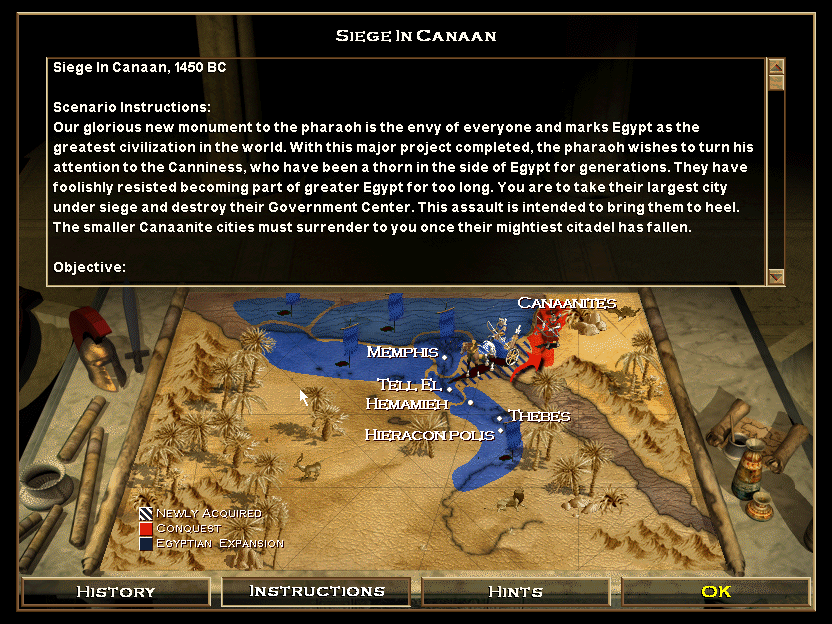
    Age of Empires screenshotAs you may know, Age of Empires is Microsoft’s ground breaking strategy game where you guide a civilization from the stage of hunter- gathers all the way up to the Iron Age. Most of these civilizations are based around the Fertile Crescent in the Middle East. You have many to choose from, each with distinct advantages and disadvantages on the path to the Iron Age. For the most part the descriptions of the tribes are historically accurate. Not surprisingly a tribe that got its start on an island chain is better at sea craft than a landlocked one. You have a choice of playing scenarios in a campaign to greatness or starting on a random map ranging from small to huge, with your choice of number of opponents and type of terrain. Be warned however that a huge map with a large number of civilizations can be taxing to even the fastest of Mac systems.

    As can be expected from this type of game there is a significant multiplayer element to Age of Empires, allowing you to play over a LAN or the internet. LAN play, unlike Civ II Gold is easy to set-up and very stable. I have played at least 6 games in varying settings and never once had a crash. I ran this on a 100baseT Ethernet LAN with Hub between a B&W 400/128 and G3 233/32. We had no problems and it was an absolute blast, even when my friend and I both got our tails kicked by computer opponents. There is a deathmatch setting in which you are given all the resources you could ever need in an elimination race for supremacy. You may play over either Appletalk or TCP/IP. I understand that there are some problems with internet based play but these problems have not caused anywhere near the outpouring of frustration caused by CivII Gold.

    Age of Empires screenshotThe interface on this game is amazingly good. Your units are large enough so that it is very hard to lose them in the fray unlike similar cases in other games of this type. As someone who has played the PC version of this game, I can tell you Macsoft have done an amazing job of improving the interface. I found the game much easier to play that the PC version. Once I got used to using the mouse and the Apple key at the same time to give orders. Never once have I had the frustration of units getting lost or not doing as I tell them. You still have to pay attention and to send units in a as straight a line as possible as to not get them hung up, but much less than other games of this type.

    The animation in this game is nothing short of amazing, even down to being able to watch each villager cut a tree and collect wood. The cut-scenes and FMV are a pleasure to behold, especially after you have emerged victorious from one scenario or other. The only real frustration in gameplay is the limit of 50 total units at any one time. The easy way to avoid this limit is either by getting some of your lesser units killed or by hitting the delete when you have selected a unit. A tad crude but effective. On the PC there was a patch which allows this limit to be overcome, hopefully we shall see this on the Mac as well.

    Age of Empires screenshotThis game is highly addicting and you can expect to lose sleep, as a result of the longer scenarios. As with most games, you know its good when you are unable to tell that time has elapsed. Playing AoE 3 or 4 hours straight when involved in a long scenario is not unusual. Fortunately, it is possible to save the game at any time and the scenario orders are available at any time in the game should you forget what you were suppose to be doing. In most of the levels it is possible to win two different ways, either achieving the victory conditions or by wiping out all your opponents. This latitude allows endless play that will keep you occupied for months to come. Those who are builder types, can even create their own scenarios to challenge their abilities.

    As far as I am concerned, this is the best game of its type ever made for any platform. I hope that Macsoft and Microsoft will be able to bring the sequel Age of Empires II, which runs from Rome to the Middle Ages to the Mac. This an absolute must for anyone who has even a passing interest in anything other than shoot’em up type games. There is enough action to keep action fans happy and enough strategy to keep strategy fans happy. I never thought Warcraft II would ever be topped in my all time great games list but Age of Empires has done just that.

    Age of Empires screenshotAn essential purchase for all mac gamers. If you rush, you can get a $10 mail-in rebate from Macsoft.

    Editor’s Note: As of 8/02/99, this is only the second game ever to get a perfect score by the MGA.

    Find a copy

    Age of Empires has been out of print for years, but used copies of the original Mac release still turn up, and some classics have been re-released for modern systems. Search for Age of Empires on Amazon.
  • Civilization 2 Gold Mac Review (1999)

    Civilization 2 Gold Mac Review (1999)

    This post has affiliate links. If you buy through them, we may earn a small commission at no extra cost to you. Learn more.

    From the archive: this review first ran on the Mac Gaming Alliance (MGA), the Mac games site that lived here on DimensionZ in the late 1990s. It was published around 1999 and is reproduced as originally written, with the original screenshots (click to enlarge). More in the Mac Gaming Alliance archive.

    Publisher MacSoft
    Tested on Power Mac 8600/300 w/32mb RAM
    Gameplay 4 / 5 apples
    Graphics & Sound 3 / 5 apples
    Interface 3 / 5 apples
    Difficulty 3 / 5 apples
    Bugs 2.5 / 5 apples
    Overall 3 / 5 apples
    Reviewed by Jonathan Dreyer

    Civilization II Gold is an upgraded version of the original Civilization II which now includes support for multiplayer and includes all of the Conflicts in Civilization and Fantastic Worlds scenarios. Other than those two items, nothing else has changed from Civilization II.

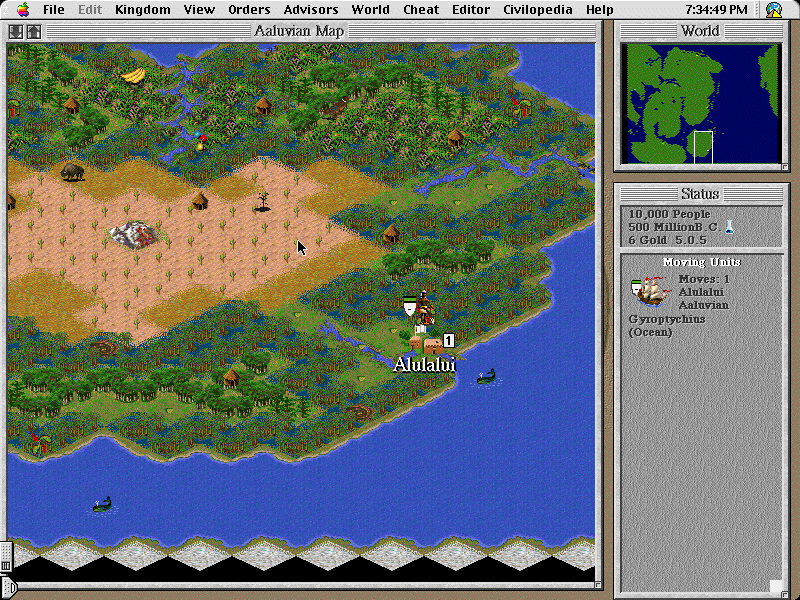
    Civilization 2 Gold screenshotThe extremely fun and addictive gameplay of Civilization II remains the same. Advance your civilization with an aspiration for worldwide domination. You can micro-manage each of your cities, or let your advisors handle the production. There are many units and buildings to construct for each of your hopefully many cities. There are treaties to be signed, and technologies to discover. Civilization II gives you a rich and complex world to dominate.

    Civilization 2 Gold screenshotThe fun of Civilization II Gold comes in the multiplayer additions. Playing your empire against another real person’s empire gives the game a lot more thrill. You can play over your Local-Area-Network, the Internet through TCP/IP, or on one computer through the “hotseat” method. Note, I would not recommend the hotseat method, unless you like getting up and sitting down a couple hundred times during a game (hence the name, hotseat).

    Civilization 2 Gold screenshotThe “Conflicts in Civilization” and “Fantastic Worlds” give you the fun of standard Civ II with the excitement of playing with all new units and lands. Defend Earth from Alien Invaders, take a side in the Civil War, these scenarios play out with a cast of characters and a plot to follow. A lot of the scenarios incorporate entirely new unit and structures for your use, greatly altering the usual gameplay.

    It appears that when adding multiplayer support, they broke a couple things… There are more than a few bugs floating around in Civ II Gold, most noticeably for me is a bug with opening saved games while file sharing is active. Hopefully a bug-fix patch will be out soon.

    Civilization 2 Gold screenshotOverall, the addition of multiplayer support, and the inclusion of the great scenario sets make Civilization II Gold a recommended buy from me, albeit a marginal one. The multiplayer aspects and the new graphics and units of some of the scenarios breathe just enough life into another otherwise tired old game to make it an enjoyable play. It did make me long for the upcoming Civilization III even more…

    Find a copy

    Civilization 2 Gold has been out of print for years, but used copies of the original Mac release still turn up, and some classics have been re-released for modern systems. Search for Civilization 2 Gold on Amazon.

  • Close Combat Mac Review (1999)

    Close Combat Mac Review (1999)

    This post has affiliate links. If you buy through them, we may earn a small commission at no extra cost to you. Learn more.

    From the archive: this review first ran on the Mac Gaming Alliance (MGA), the Mac games site that lived here on DimensionZ in the late 1990s. It was published around 1999 and is reproduced as originally written. More in the Mac Gaming Alliance archive.

    Publisher Microsoft
    Tested on PowerMac 6500/200
    Gameplay 5 / 5 apples
    Graphics & Sound 4 / 5 apples
    Interface 5 / 5 apples
    Difficulty 5 / 5 apples
    Bugs 3 / 5 apples
    Overall 4.5 / 5 apples
    Reviewed by J. Driver

    Close Combat is a World War II simulation. In this game, you control American Allied units who just landed in Normandy, or German troops attempting to hold their ground. Not everything can go according to plan, however, because your troops, and enemy troops, can become mentally unstable, either to your advantage or to the enemy’s advantage. Video coverage of the actual D-Day campaign shows you what you need to do, what you did, and what really happened.

    Gameplay

    Close Combat requires a Power Macintosh due to large amounts of information it has to process. Gameplay is typically very fast. You will really feel that you are really commanding troops in Normandy.

    Graphics and Sound

    The graphics in Close Combat are very good, for the most part. They can appear “grainy” during combat when you have magnified the battlefield 100%. Sound in Close Combat is also very good, and unlike graphics, it does not falter.

    Interface

    The interface in Close Combat is very simple: point and click. In the battlefield, there are also added conveniences in terms of buttons. Move out, Defend, and Pull Back lets you control all your troops without having to control each team.

    Difficulty

    Even on the Easy level, Close Combat is a very difficult game. Sometimes the only way to get past a particular battle is to do your best and refight it, that way the enemy is weakened.

    Conclusion

    Close Combat is a very good game. While the graphics could use a little work, the rest of the game is done very nicely and realistically.

    Find a copy

    Close Combat has been out of print for years, but used copies of the original Mac release still turn up, and some classics have been re-released for modern systems. Search for Close Combat on Amazon.

  • Starcraft Mac Review (1998)

    Starcraft Mac Review (1998)

    This post has affiliate links. If you buy through them, we may earn a small commission at no extra cost to you. Learn more.

    From the archive: this review first ran on the Mac Gaming Alliance (MGA), the Mac games site that lived here on DimensionZ in the late 1990s. It was published October 1998 and is reproduced as originally written, with the original screenshots (click to enlarge). More in the Mac Gaming Alliance archive.

    Publisher Blizzard
    Tested on Power Mac 8600/300 w/32mb RAM
    Gameplay 4 / 5 apples
    Graphics & Sound 3 / 5 apples
    Interface 4.5 / 5 apples
    Difficulty 2.5 / 5 apples
    Bugs 5 / 5 apples
    Overall 3.5 / 5 apples
    Reviewed by Jonathan Dreyer

    The Mac version of Starcraft suffered a great many set-backs during it’s port from the PC. It is a full year late from it’s originally scheduled release. Starcraft was plagued with bad luck and just as it looked like it was going to make the 98 holiday season, it was delayed again, bringing it to it’s March 99 final release. Starcraft, like it’s predecessors Warcraft, features stunning between level film sequences and challenging 2D gameplay.

    Starcraft allows you to choose from three races, Human, Zerg, and Protoss. Each race has it’s own set of units and abilities. Starcraft utilizes the same gameplay style that Blizzard defined years earlier with the original Warcraft, you control everything. You have to tell the barracks to train more troops, and then you have to give those troops their orders. Like all strategy games of this type, it becomes difficulty to keep track of all your units when you have a particularly large base.

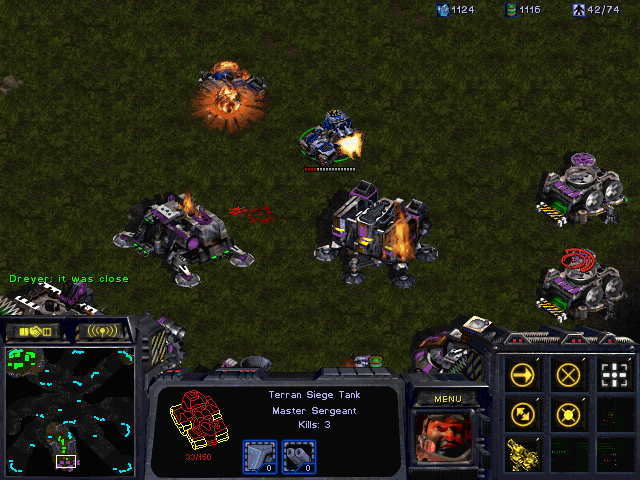
    Starcraft screenshotStarcraft also sports a more complete and complex storyline than the Warcraft series. It is set as a series of campaigns where you start as Human and end up as Protoss. You can’t move on to the Zerg campaign until you have completed the Human one. The Starcraft campaigns feature challenging missions too, not the usual “build up your base and annihilate the enemy” type mission common to most strategy games. There are complex missions when certain individual units must survive or you must steal computer files by sneaking in an enemy’s base. Those type of missions are certainly the most enjoyable.

    Of course, the best part of Starcraft is the multiplayer system over Blizzard’s free Battle.Net servers. There are numerous Blizzard made and third-party maps available. Some maps are complex games within a game involving scoring points over a limited time period. Beating our PC brethren who have been playing for more than a year now is fun too. The Battle.net servers keep track of your wins and loses and there are also ladder events and tournaments in which you can win real prizes.

    Starcraft screenshotGraphics is an area where Starcraft suffers greatly. Sadly, in the time that it took them to port Starcraft, the 2D graphics have become almost antiquated in a market where most new strategy games are using 3D. Still, Starcraft’s graphics are for the most part bright well done. Had it been released on time last year, Starcraft would have scored 4 apples.

    Starcraft’s interface is not lacking. It uses Apple’s inputsprockets to control two-button mice and gamepads, allowing iMac users to use their fancy USB muli-button mice. SC features all the important options boxes allowing the user to adjust things like sound effects volume, brightness, and even network options to prevent lag and slowdowns in muliplayer games.

    You would expect from all the delays that when Starcraft finally did ship that it would be absolutly bug-free, and you would be right. Starcraft is, as far as I can tell, completly bug-free. I did not run across any problems over the many hours of reviewing.

    Starcraft screenshotIn conclusion, Starcraft is an excellent strategy games that suffers unfairly because of it’s long delayed release. While no longer on the cutting edge, Starcraft is still a strong recommendation to buy. It offers great replayability throught the multiplayer aspect, and has challenging single-player campaigns to work your way through.

    For even more screenshots, visit our earlier Starcraft Preview

    Find a copy

    Starcraft has been out of print for years, but used copies of the original Mac release still turn up, and some classics have been re-released for modern systems. Search for Starcraft on Amazon.

  • Star Control 3 Mac Review (1998)

    Star Control 3 Mac Review (1998)

    This post has affiliate links. If you buy through them, we may earn a small commission at no extra cost to you. Learn more.

    From the archive: this review first ran on the Mac Gaming Alliance (MGA), the Mac games site that lived here on DimensionZ in the late 1990s. It was published June 1998 and is reproduced as originally written. More in the Mac Gaming Alliance archive.

    Publisher MacSoft
    Tested on PowerMac 7100/66
    Gameplay 4.5 / 5 apples
    Graphics & Sound 4 / 5 apples
    Interface 4 / 5 apples
    Difficulty 4.5 / 5 apples
    Bugs 5 / 5 apples
    Overall 4.5 / 5 apples
    Reviewed by David Leinbach

    Introduction

    Travel through hyperspace has now become impossible due to interdimensional fatigue. Now you have built a ship from Precursor technology which uses warp bubble technology to travel great distances. To try and reverse the collapse of hyperspace, you and a number of teams travel to the Kessari Quadrant. Unfortunately, the nature of the precursor ship scattered the teams throughout the Kessari Quadrant. Your mission is to rediscover the teams and restore hyperspace.

    Gameplay

    In MacSoft’s Star Control 3, you can play a normal game or you can jump right to battle’s with enemy ships. In Hyper Melee mode you can configure yours and your enemy’s fleet including the number of ships, and the types of ships. You can also choose whether you wish to use mouse or keyboard control, the skill of the computer and you can even play Hyper Melee mode over the modem. Once you have setup the game, you choose a ships, one at a time, to battle in one-on-one battles until only you or the enemy’s fleet remains. In battle, you can easily control you ship from the arrow pad, Ctrl, and Option key for player one and C, V, B, X, and Z for player 2(in a human vs. human game). You can change the view and speed the improve the amount of enjoyment received from this mode of play.
    In Adventure Game mode, you must locate the teams and new alien races plus you must colonize new worlds to gain resources for ships. Lastly, you must discover Precursor alien artifacts which may help in reversing interdimensional fatigue. Once you get into the game, you will learn that you of another race which has only been referred to as the Eternal Ones who feed on other races and they may be the cause of all your problems. While fulfilling your mission, you will encounter races who will not take kindly to your presence and may force you into battle. Once you enter battle, the computer will choose one of your ships and one of the enemy’s(if there are more than one). They will then enter battle. One complaint I do have is that you cannot control your own ships.

    Graphics & Sound

    The graphics in this game are very well done. What more can I say? The in-game movies are partially blocky however most of them, including the alien races who look nothing like human actors, look as if they were just recorded onto the computer using an electronic video camera.
    The sound is almost as professionally done as the graphics but they are not as realistic as would be preferred. Some of the gun shots sound as if they were created in 5 minutes. Even so, I found that the gameplay distracted me enough that I didn’t notice it that much.

    Interface

    This game has a fairly intuitive interface. I was able to learn to use most of the functions of this game without having to read the manual. Most of the buttons use graphics that allow you to easily navigate through the game and actually succeed. The method of transferring crew from ship to ship to colony and back is easily implemented by clicking on the source/destination and selecting how many people you want left on you head ship. Selecting how much resources to allocate to each industry in a colony is accomplished by moving a slider control. The only complaint I have relating to the interface is that while in communication with some aliens, your choices available are severely limited at times. One limitation that I wish they had removed was that you cannot exit a communication at any time.

    Difficulty & Bugs

    I almost wrote that this game had a perfect difficulty level when I realized that this was not true. This game almost had a perfect difficulty level but I found it too easy which is why I thought it was perfect because I was able to win in this game. As you play the game gets harder because you must battle ships which have an increasing difficulty and you must solve some difficult problems.
    As for bugs in this game, I encountered none except for what could be considered a bug but also could be blamed on the hardware. While playing the introductory movies at the beginning of the game, the sound was really choppy. Other than that, the game seemed fine.

    Conclusion

    This game is a very enjoyable diversion from the normal types of games. When I started playing this game I thought that it would be boring but I ended up playing for 4 hours straight. Anyone who enjoys strategy games will definitely enjoy this game and I am almost positive that anyone will enjoy playing this game. The amount of thought that this game requires is enough that you won’t get bored because of it being to easy while at the same time is not so much that you decide to give up because of boredom in that way. Overall, if you have a CD-ROM drive of 4x or faster then you should definitely consider this game.

    Find a copy

    Star Control 3 has been out of print for years, but used copies of the original Mac release still turn up, and some classics have been re-released for modern systems. Search for Star Control 3 on Amazon.

  • Deadlock Mac Review (1998)

    Deadlock Mac Review (1998)

    This post has affiliate links. If you buy through them, we may earn a small commission at no extra cost to you. Learn more.

    From the archive: this review first ran on the Mac Gaming Alliance (MGA), the Mac games site that lived here on DimensionZ in the late 1990s. It was published March 1998 and is reproduced as originally written, with the original screenshots (click to enlarge). More in the Mac Gaming Alliance archive.

    Publisher Macsoft
    Tested on LC 475
    Gameplay 3 / 5 apples
    Graphics & Sound 4 / 5 apples
    Interface 3 / 5 apples
    Difficulty 5 / 5 apples
    Bugs 5 / 5 apples
    Overall 4 / 5 apples
    Reviewed by Ben Kilford

    Beneath you floats the untamed Gallius 5. A newly discovered planet in the disputed part of the galaxy. A colony ship is ready, equipped with all the basics you need to settle on this planet. The select group of colonists orbiting with you are prepared both to build a strong colony and defend it to the last stone.

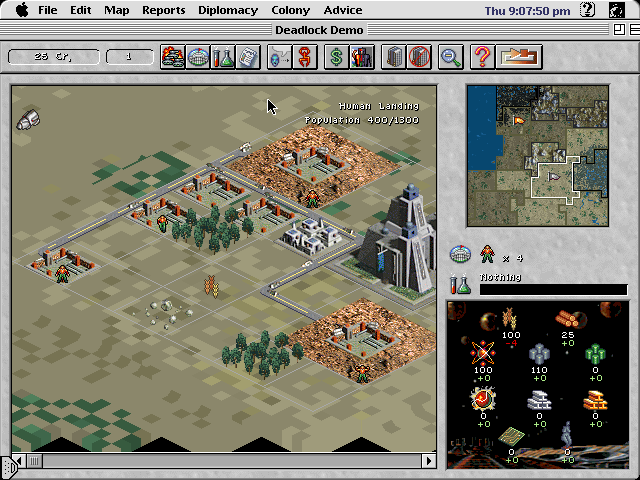
    Deadlock screenshot(Click to Expand)

    Game Play

    The game play is pretty good you lead a group of colonists in a fight for a planet. You can have unlimited play which you set up however you like. For example you choose the number of other colonies fighting for the planet and how many city centers are to be built to win. Mac Soft have put in a very useful tutorial which will show you the basics. You use a mouse to do most of the controlling, such as building and to attack you enemy. As you expand your territory you will encounter your enemy and may have to go to war. The one thing that I did not like is you have to end your turn to make progress instead of it doing it automatically.

    Deadlock screenshot(Click to Expand)

    Graphics and Sound

    The introductory graphics are excellent because they are realistic, they show you what the planet looks like and introduces the Characters. When the game starts the graphics become less impressive, they are not as realistic and the characters lack detail. The sound effects are quite pleasing, particularly the squeeks and beeps. However the background music becomes annoying because of constant repetition.

    Interface

    I liked the way the interface was laid out. Your menu bar is at the top of the screen and a simple click will activate each box.

    Difficulty & Bugs

    The level of play ranges from novice to expert. Players can play against the computer or on a network of computers. The level of difficulty depends on the number of city centers to be built and the number of Characters activated. There were no bugs that I was aware of during the time I used this program.

    Deadlock screenshot(Click to Expand)

    Conclusion

    I enjoyed playing Deadlock. There was a lot to do during the game. I feel it is rather similar to SimCity but better. I rather like the feature that allows one to fight against their enemy. This is an excellent building and alien busting game full of technology and some new design methods.

    Find a copy

    Deadlock has been out of print for years, but used copies of the original Mac release still turn up, and some classics have been re-released for modern systems. Search for Deadlock on Amazon.

  • Castles: Siege & Conquest Mac Review (1998)

    Castles: Siege & Conquest Mac Review (1998)

    This post has affiliate links. If you buy through them, we may earn a small commission at no extra cost to you. Learn more.

    From the archive: this review first ran on the Mac Gaming Alliance (MGA), the Mac games site that lived here on DimensionZ in the late 1990s. It was published around 1998 and is reproduced as originally written. More in the Mac Gaming Alliance archive.

    Publisher MacPlay
    Tested on LC475 (25MHz 68LC040)
    Gameplay 4 / 5 apples
    Graphics & Sound 3 / 5 apples
    Interface 5 / 5 apples
    Difficulty 5 / 5 apples
    Bugs 5 / 5 apples
    Overall 4 / 5 apples
    Reviewed by Jon Ostenson

    Castles: Siege & Conquest is set in the middle of chaotic 14th-century France, a time of great bloodshed and contention for the throne of France. During the course of the game you will conquer territories, build castles on them to ensure their allegiance to you, and maintain a delicate balance between the political, economic, and military aspects of your realm. You also have to keep your people happy and maintain a good relationship with the Pope. Your ultimate goal is to become king; to do so, you’ll need to gather enough might and resources and petition the Pope to declare you king. If he grants your request, you’ll win the game. If another player successfully petitions the Pope first, you lose.

    Gameplay & Interface
    An attractive graphical interface also serves to easily give you access to all of the game’s commands. Events take place in real-time, so it would be easy for the game to get out of hand, but MacPlay has done a good job of making the interface work to your benefit. There are numerous tutorials included with the CD-ROM version that introduce you nicely to the game’s features and what it will take to be successful. These tutorials function much like Apple’s AppleGuide, taking you step-by-step through the game’s interface and commands.
    Quicktime movies and sound clips of old black and white movies add some realism and, at times, humor to the game. These clips often introduce numerous side plot lines that will demand your attention at the same time as you seek to conquer the realm. Successfully navigating through these plots may influence your relations with the Pope (an all-important figure in this game), alleviate your people’s sufferings, or increase your stockpiles of resources.
    As you move along conquering territories and subjugating enemies, you’ll need to build castles on your lands to ensure their allegiance to you. The castle design stage allows you to either design your own or choose from historically-based designs. If you do choose to design your own castle, the process is simple and intuitive (and kinda fun!). Once you lose your first territory to rebellion, you’ll understand the importance of these castles.

    Difficulty & Replayability
    Castles provides four different levels of difficulty (ranging from Easy to Impossible) that should provide many hours of challenge. You may also play as any of five different lords, each situated in different geographical areas of the map. As you try to conquer the other lords in the land, you can take a number of approaches (I.e., military domination, economic domination, etc.). These different factors make for a practically unlimited number of scenarios.
    This is not an easy game, even at the simplest level. It will be long months before you’re in a position to petition the Pope, and then after you petition him you must keep you total points above a certain level to keep his attention.

    Graphics & Sound
    Castles’ graphics are nice, but nothing to write home about.Likewise, there’s some nice sound effects, music, and speech, but this game won’t make you run out and buy some Bose for your Mac. This isn’t a game, though, that relies heavily on multimedia, but instead on strategy and skill. In those areas it is very successful.

    Find a copy

    Castles: Siege & Conquest has been out of print for years, but used copies of the original Mac release still turn up, and some classics have been re-released for modern systems. Search for Castles: Siege & Conquest on Amazon.

  • Imperialism Mac Review (1998)

    Imperialism Mac Review (1998)

    This post has affiliate links. If you buy through them, we may earn a small commission at no extra cost to you. Learn more.

    From the archive: this review first ran on the Mac Gaming Alliance (MGA), the Mac games site that lived here on DimensionZ in the late 1990s. It was published around 1998 and is reproduced as originally written. More in the Mac Gaming Alliance archive.

    Publisher SSI
    Tested on PowerMac 7500/120Mhz
    Gameplay 5 / 5 apples
    Graphics & Sound 4 / 5 apples
    Interface 5 / 5 apples
    Difficulty 5 / 5 apples
    Bugs 5 / 5 apples
    Overall 5 / 5 apples
    Reviewed by Ian Russell

    Imperialism is a game of development and conquest like Civilization, but in Imperialism you conquer the world in style. The game, set in the 19th century, focuses not so much on brute force military domination as expansion through economic development, trade, diplomacy and finesse. Of course, for you hard core war gamers out there, you can crush your enemies under the treads of your tanks and take every battle down to the tactical level, fighting out your individual battles unit to unit, saber to bayonet, if you want. This game features a sophisticated AI, some of the most advanced computer diplomacy for the genre and a wonderfully crafted economic model, each of which compliments the other beautifully into a tightly woven strategy game not to be missed.

    Gameplay & Interface

    Gameplay in Imperialism is its finest asset. Your empire operates in a complicated web of material and monetary interdependencies. It is usually not until late in the game that your country becomes completely self sufficient. In this respect, it is very unlike Civilization or Colonization. You simply cannot afford to run your country like an island with your foreign relations limited to the end of a gun. This web of economic interdependency is nicely complimented with a sophisticated diplomatic AI that will boycott you economically if you appear too aggressive or attack you militarily if you become too weak. In every case, the player must balance his desire for military conquest against the likely response by the international community upon whom he depends for raw materials and monetary income, without which he cannot build reinforcements for his armies, upgrade his factories or train new workers. All the while, the player must woo smaller countries into his protection so that he can develop more dependable economic ties to them to secure his future production in the war torn days to come.

    The game typically goes through several phases. There is an initial exponential growth phase (usually typified by the flat part of the exponential growth curve) in which the player tries to build domestic infrastructure, trading relationships and industrial capacity as quickly as possible. Once local supplies of materials become inadequate to your needs, the game progress to its second phase, which is intensely political. All of the major countries compete for advantageous trade agreements with the lesser countries, with an eye towards making them colonial protectorates. How well you succeeded in early phases of the game can influence how well you can take advantage of the added resources made available from your colonies. When all of the lesser countries have chosen sides, the game enters a late stage zerosum end game in which the battle lines have been drawn and every gain is another major power’s loss. If you have not already won by this point (every ten years, the countries vote for the most dominant player in the game) then the Napoleonic conquests begin. Great armies mobilize, major power alliances can shift and bend, and you might find yourself warring with another country far longer than you wish to in order to protect hard won alliances which keep your shores safe from aggression.

    Almost every aspect of Imperialism is rich with diversity. In contrast to Civ’s single settler unit, Imperialism has a prospector, a miner, a farmer, a rancher, a lumberjack, an enginner, a wildcatter and a developer who’s sole job it is to buy land in other countries for development, with the ultimate hope that these countries will then sell those resources to you of course, they might not! Likewise there are eight land military units plus two technological upgrades for each unit type which can significantly alter tactics during battle, and up to eight different naval unit types at any given time. Finally, you develop eight different factories to produce different types of goods for export to pay for your expenditures. There are approximately twenty commodities in all, to be bought, sold, traded, shipped and refined. I never felt short changed or oversimplified in any area, except perhaps for naval units. There is no tactical engine for naval units. Battles just happen and you find out about it later. You won’t be capping any T’s in this game.

    The Imperialism interface is very clean and uncomplicated, allowing you to focus on the game’s best features: strategy, diplomacy and empire building. The programmers worked hard to eliminate the rampant micromanagement present in most strategic games. They did so by reducing the number of micromanageable economic centers to one, your capital. All the rest manage their own affairs and simply add their economic output to your transportation network for transport to your capital city for processing and refinement. Your military units move in groups as armies, which may be divided and combined as necessary, greatly simplifying the task of piece movement. All diplomacy is handled in a diplomacy window, which is accessible from a single click just about anywhere. Likewise, trade and production each have their own easily accessible windows which allow for quick adjustment of production and trade to feed your growing empire. You do not have to wait for the computer opponents to move at all. All moves are handled simultaneously, much like in diplomacy. Battle reports are concise and informative and you have the option of micromanaging the land battles yourself if you like. Technological development seems slower than in civilization, but considering the historical time period the game covers (mid 19th century to early 20th century), and that turn lengths are measured in months and not decades, that is to be expected. The technology advances are real, for example square frame timbering for mines or rifling for guns, not like the contrived advances in Colonization.

    Graphics & Sound

    The graphics and sound in Imperialism are unexceptional. They are not bad, nor do they detract from the gameplay, but they lack any special eye candy that modern gaming afficionados might find interesting, such as rippling water, a detailed 3D interface, or impressive special effects. Views are usually either 2D or 3D with a rather flat appearance. The maps are obviously hex based, with no attempt to hide the grid like in Warcraft, Conquest of the New World or Command and Conquer. Perhaps simply to address criticisms such as these (small though they may be), there are several video clips which break into the game from time to time which can certainly be classified eye and ear candy. The sounds is not smashing. In a quality pair of headphones, it is clear that the sound sampling rate in these video clips is not 22 kHz, or possibly the soundtrack went through a hiss laden cassette tape at one point! Unfortunately, these video clips don’t really add much to the game, and after the initial viewing, just serve to delay your progress. Fortunately, they don’t appear very often and can be dismissed with a single mouse click to get back to the real business at hand, which is quite interesting indeed! Let it be clear that for all its unexceptional aesthetic qualities, the graphics are very functional, and do not detract from the game in any way. In some ways, their simplicity is a boon to the game, an extension of a simple and well thought out interface.

    Difficulty & Replayability

    Imperialism is a challenging game, with an array of difficulty levels to challenge conquerors of all levels — from the Napoleans of the world to timid knights easily defeated by shrubbery. Challenges come from all sides. You will be faced with an initially severely constrained economic system and raw materials shortages. Diplomacy is expensive and you will need money. For that you need goods to sell. You will have to locate and transport raw materials to the capital, build factories to process them and ships to sell the processed goods. Mines will need to be dug, fields plowed, trees chopped, oil drilled for, and railroads and ships built. Lastly, you will need to provide for your defense and ultimately develop a military industrial complex which can satisfy the needs of a great military power. In each case, having the right allies is key to your success. They supply raw materials, buy your products, sometimes protect your shores, boycott and blockade your enemy and help you conquer enemy lands.

    Imperialism has a fairly high replay value, but it could be better. Chiefly detracting from the replay value is the lack of computer opponent diversity — all the computer opponents play identically. Fortunately, Imperialism can be played over the net against human opponents which should resolve this problem, or would if you could find other macintosh players. Currently, Imperialism does not allow you to play against people on Wintel machines — despite the fact that both versions come in the same box. Fortunately, if you do have access to an x86 clone, then you can use your CD to play Imperialism on it. No need to buy an extra copy.

    Caveats

    The CD must be in the drive to play the game. Users without a CD-ROM drive, such as most powerbook users, can use the CD, Disk Copy and a borrowed CD-ROM drive to make a 115 MB disk image to replace the CD. The mac version of the game will not play networked games against the PC version of the game. Networked games may be played by TCP/IP or Appletalk. The CD comes with both x86 and PowerMac versions on it. This means that whatever computer you buy next, the game will run. It also means that you may have to look in the PC games area to find it in your favorite computer superstore. I encountered no bugs to speak of.

    Conclusion

    Imperialism is a must play. Its intricacies are complex and nuances subtle and its economic and diplomatic components cannot be ignored, so it may not be for players who live for brute force combat alone. For these people, there are other SSI products like Panzer General. Imperialism is perhaps the most interesting game from the Civilization genre I have ever played, and comes highly recommended. It’s interface is clean and micro-managment is kept to a minimum. Even late in the game, turns continue to move quickly. The computer AI is sophisticated and well integrated into the game. However, I expect that where the game truly shines brightest is in multiplayer play. Better start searching for macintosh players though, since SSI did not see fit to make net games with PC players a possibility.

    For a list of mac and PC Imperialism net players and forming net games, check http://www.concentric.net/~tfumia/Imperialism.shtml

    Find a copy

    Imperialism has been out of print for years, but used copies of the original Mac release still turn up, and some classics have been re-released for modern systems. Search for Imperialism on Amazon.

  • Master of Orion II Mac Review (1998)

    Master of Orion II Mac Review (1998)

    This post has affiliate links. If you buy through them, we may earn a small commission at no extra cost to you. Learn more.

    From the archive: this review first ran on the Mac Gaming Alliance (MGA), the Mac games site that lived here on DimensionZ in the late 1990s. It was published around 1998 and is reproduced as originally written. More in the Mac Gaming Alliance archive.

    Publisher MacSoft
    Tested on PowerMac 7600/120
    Gameplay 3 / 5 apples
    Graphics & Sound 4 / 5 apples
    Interface 2 / 5 apples
    Difficulty 4 / 5 apples
    Bugs 4 / 5 apples
    Overall 3 / 5 apples
    Reviewed by Cale Corbett

    Gameplay

    Master of Orion II is saddled with the same sort of baggage many games of its genre: clunky interface and distinct lack of originality. I will touch more on the interface issues later in the review, but for now, let’s focus on the aspect of originality. Not only is Master of Orion II very much like other space and land-based strategic games (like Civilizations I & II), it is hauntingly similar to the original Master of Orion. Granted, the graphics, sounds and gameplay in general has improved over the original, it is not a radical enough departure to entice this rather jaded gamer into calling it “insanely great.” Yet, given all that, it is still a fun game to play and has provided me with hours of visceral thrills in the past two weeks.

    The game has varying levels of difficulty, from a hand-holding level to a level that only the most masochistic gamer could tolerate.

    One serious issue for gameplay for seemingly hundreds of Macintosh Master of Orion II players has been the glacial pace at which the game seems to crawl in many places. Many have complained the mouse pointer jerks and jumps around the screen. Others have noted that the further the game progresses, especially with larger galaxies and more players, the longer it takes for control to be returned to the gamer. Some have reported lags of two minutes or more on relatively new and speedy Macintoshes. A few have pointed out that turning off Virtual Memory speeds game play significantly, but for many with little RAM this is not always an option.

    Graphics and Sound

    The graphics and sound in this game are polished, refined and professional. The game is spiced up with the occasional scene of a planet being bombarded, massive fleets of enemy vessels pulling up alongside your system and other little surprise morsels thrown in for good measure. The sound is smooth, clear and crisp. Unlike most games of this type, the background music is not annoying and distracting.

    Interface

    The interface is rated rather low for two important reasons. One, the interface is clunky, PC-like and two, the Finder is conspicuously absent during game play. You are literally stuck with quitting the game to get back to the Finder unless you have installed a third party application-switching extension. Such issues may be complete non-issues for PC gamers, but we Mac gamers expect a little something more from our games, a pleasant and easy to use interface.

    Difficulty and Replayability

    This game has (as noted above) varying levels of difficulty, with enough to keep all but the most serious strategy gameplayer hopping. Given that the game has so many levels, races and the option to create your own custom race (with various abilities and disabilities) you can expect to have many hours of rewarding gameplay. If nothing else, experimenting and battling with the many thousands of spacecraft combinations alone could consume years.

    Bugs

    Many 68k Mac gamers have reported Type 28 errors while playing Master of Orion II, particularly when changing production targets. I have seen very few, if any, similar complaints from PowerMac users. Overall, this is a stable, and competent port.

    Conclusion

    This game is a decent, solid, if rather uninspired creation. It is no secret from the interface or the gameplay that it is a PC port. However, it is a fun, engaging and sometimes downright engrossing distraction from daily life. If you enjoy games of this type, pick it up.

    Find a copy

    Master of Orion II has been out of print for years, but used copies of the original Mac release still turn up, and some classics have been re-released for modern systems. Search for Master of Orion II on Amazon.

  • Myth: The Fallen Lords Mac Review (1998)

    Myth: The Fallen Lords Mac Review (1998)

    This post has affiliate links. If you buy through them, we may earn a small commission at no extra cost to you. Learn more.

    From the archive: this review first ran on the Mac Gaming Alliance (MGA), the Mac games site that lived here on DimensionZ in the late 1990s. It was published around 1998 and is reproduced as originally written. More in the Mac Gaming Alliance archive.

    Publisher Bungie
    Tested on StarMax 4000/200 with Techworks Power3Dfx card
    Gameplay 3 / 5 apples
    Interface 3 / 5 apples
    Difficulty 2 / 5 apples
    Bugs 3 / 5 apples
    Overall 3 / 5 apples
    Reviewed by Marty Dodge

    Myth is Bungie’s new big game for both the PC and the Mac. The hype said it was going to be the best thing since…well since the invention of the computer game. Does it live up to the hype? Well no, and yes depending on what you want from a game. Graphically it is an amazing piece of work. There is nothing quite like lowering your camera close enough to see one of the characters on the screen being hacked apart by one or other of the evil nasties about.

    I do have a few gripes:

    1. The difficulty ratings seem to be useless and do not matter one bit. I could see no difference between timid and normal. The learning curve on Myth is way too long and will annoy anyone with a real job who does not have hours and hours to learn it. If you have the time and use some of the guides on-line the game gets quite enjoyable in the end. But getting to a level of competence required to make it fun is really annoying. I really hate having to do the same level 10 times before getting it right. The game controls are fiddly as well.

    2. Your men are way too stupid. The dwarf seems to have an equal or better chance of killing himself before the enemy. If you were a dwarf and you had a baddie with a sword chasing you, you would run like hell when the baddies get close. In fact none of the men in this game seem to have any intelligence at all. They will stand still and get slaughtered to a man. Unless you tell them to run. Surely, that should happen almost automatically and the player should have hard time getting them back if they run off. In most war games this is called: failing morale. The enemy seem to be much brighter than then men you are given. Most of them are undead, as well. In real life I would go back to base camp and kill whomever gave me all archers for the second mission: “Traitors Gate”. Long range weapons in a heavily wooded area: yea right.

    3. My last annoyance is the fact that one is not able to play the “Fallen Lords.” One of the great things about Warcraft II, the game which Myth will be compared to most frequently, is that one is able to play the “baddies.” I find it much more fun to make the human’s lives a misery. Frankly there is nothing better than slaughtering a whole load of your human opponents and then raising them from the dead in order to send them back against their horrified comrades.

    I have a 3DFX card and the game is amazing to watch, the opening sequence looks as if it is from a Disney epic. Combat is incredible to watch as you see your men slaughtered to a man. The fact you can swing the “camera” around to see all angles of the action is pretty impressive. It does sometime however seem that you are merely a bystander watching the action as it unfolds with little or no input. For instance, as far as I can tell, telling your men to retreat only serves in turning the back to the enemy allowing them to be killed more quickly. “Retreat” should mean: run like hell.

    I made several attempts at LAN (Appletalk) play and managed to succeed in getting it working only once. The only time the multiplayer function worked was when I left all the settings on default. Any adjustments and the “joiner” froze. Seeing as Myth is from Bungie, experts at Mac based LAN games, my difficulties were disappointing. My PC friends are always amazed at the speed and ease of setting up LAN games with Marathon.

    Ultimately I think Bungie made an excellent attempt taking strategy games to a higher level. Myth misses the mark. A bit too “graphics over gameplay” for my liking. Many of my complaints may well be corrected in subsequent versions of the game. I used a “gold” review copy from Softline here in the UK. Bungie is an excellent game company and I am in no doubt that they will take a keen interest in any criticism of the game. There are rumors about that there will be an update on-line sometime in the next week. It is my hope great hope that Myth II, which there will no doubt be, will prove an amazing game that will blow away anything in its path. I am afraid that until then, for sheer strategy enjoyment (esp. multiplayer), give me Warcraft II anytime.

    Find a copy

    Myth: The Fallen Lords has been out of print for years, but used copies of the original Mac release still turn up, and some classics have been re-released for modern systems. Search for Myth: The Fallen Lords on Amazon.